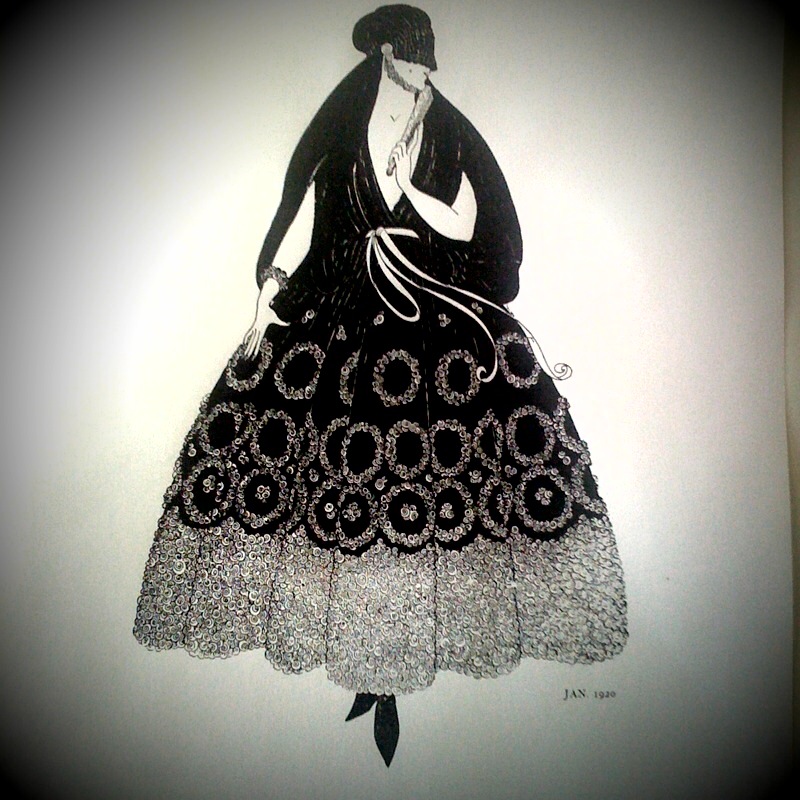
Tuesday, September 28, 2010

✂-Designer's Tip of The Day-Pop Art!!

Pop Art, drawing it's inspiration from the imagery of consumer marketing and popular culture, was destined to connect with the world of fashion.  Pop Art emerged around 1960, primarily in New York and London, where artists were painting bold and colorful images of everyday objects,often distorting their appearances through enlargement, repetition, or isolation.  Many of these artists became famous, and their paintings became icons of the 1960's: Andy Warhol and his Campell's soup cans, Roy Lichtenstein and his comic-strip paintings and Robert Indiana and his huge LOVE painting.
Warhol was the most closely connected to fashion.  The best "Pop Art" fashion, however, was that produced by designers who copied Pop Art's bold iconographic look.  This meant it was often called a "Warhol" look.  Many designers such as Betsey Johnson, Gianni Versace, and even the French designer Yves Saint Laurent were inspired by the Pop Art movement.

Pop Art is seen in the current fashions of today, however, it's origin is slowly being forgotten.  Sleek cocktail dresses, printed with repetitious images, TV cartoon characters or Day-Glo colors are a hommage a' Warhol.

As Andy Warhol once said "If everybody's not a beauty, than nobody is!"

Source: Icons of Fashion, 20th Century. by Prestel Publishing

Monday, September 27, 2010

✂-Designer's Tip of The Day-Pattern Organization!

When a pattern maker creates a new or first pattern a Pattern Form is usually attached.  I recommend creating a pattern form to keep all your patterns numbered and organized.  The form above is one we use here at The Designer's Lounge and was created in Adobe Illustrator, but can easily be created in Microsoft Excel.

You will need the following columns:
1. Number of the pattern piece
2. Description of the pattern piece
3. Cut #, indicate which pieces are "cut on fold"
4. Style, Size and Yardage information.
5. Space for a sketch or picture
6. Trim Info

Patterns can be hung on pattern hooks OR keep the patterns in large Ziplock Bags with pattern sheet on the front.

Saturday, September 25, 2010

✂-Designer's Tip of The Day-Patou


Jean Patou, born in Normandy in 1880, but it was in the 1920's that he became known as one of the greatest French Fashion Designer's of our time.
The House of  Patou still presents exactly the same face to its clients as it did in the twenties when the salons were first designed for Jean Patou.  It was in these salons that one of the most famous names in Paris couture in the twenties practised what Edna, Mrs Woolman Chase, then Vogue's editor in cheif, described as 'high art and heavy industry'.  
He was known for designing "sports clothes", amusing cubist sweaters and bathing suits, but he was most recognized for inventing Joy, promoted as the most expensive scent in the world.  Three generations later, Joy is still one of the most popular perfumes.
His monument is our freedom to wear comfortable, stylish sports clothes.  Style is permanent and timeless, fashion is short-lived, and Patou was always more concerned with fashion, with the moment and the mood, than he was with timelessness.  Patou was once asked what he thought would be fashionable in the future.  "Fashion is not a subject of deduction, like a system of logic," he replied. "It is made up of a thousand different influences.  Fashion is a living thing and, in consequence, evolves from day to day, from hour to hour and from minute to minute."   Jean Patou's minute spanned a decade.

Patou died in 1936.  But every time a woman buys a bottle of Joy, every time a striped sweater is pulled down over a pleated skirt, every time real sports clothes are used as an inspiration for fashion design, Patou survives.


Source: PATOU by Meredith Etherington-Smith

Thursday, September 23, 2010

✂-Designer's Tip of The Day-Clipping!


When draping a fitted style, it can be difficult to smooth the fabric along the dress form, gathers or "ripples" may occur.  To eliminate the ripples, clip into the fabric at waist to release, continue to smooth fabric over the dress form so that fabric lays flat.

Wednesday, September 22, 2010

✂-Designer's Tip of The Day-Loosely Woven Fabrics


Fabric Characteristics:
-Loosely woven fabrics are easy to shape and ease.
-Many loosely woven fabrics fray badly- Suggest to spray the edges with fray retardant before proceeding into sewing.
-Most loosely woven fabrics slip at stressed seams.

Loosely woven fabrics are suitable for a variety of garments: skirts, coats, slacks, tailored jackets, soft suits, and dresses.  To showcase the fabric, choose a simple design with a minimum of seeams.  Avoid closely-fitted designs and superfluous details. 
Or follow the example set by Ms. Coco Chanel in her classic suits and line the garment to the edge to eliminate the necessity of facings!

 Source: Claire Shaeffer's Gabric Sewing Guide,
Fabric shown above is a Silk/Rayon Blend, Black and Ivory Plaid.

Friday, September 17, 2010

✂-Designer's Tip of The Day-Start With a Muslin

A Muslin sample is a great way to fit a new pattern or an "experimental" pattern without ruining a nice piece of fabric.  By sewing a sample made of muslin you are able to test the construction of a new pattern and it allows you to mark up the changes and adjustments during a fitting.  It's really easy to refer back to your muslin when making the changes to your pattern.
I would suggest using a weight that is as close as possible to your actual fabric, as well as similar in weave or construction.  Better to work with a less expensive fabric than to cut into that fabulous silk from France! (If only I had fabulous silk from France....).
Happy Friday!

Thursday, September 16, 2010

✂-Designer's Tip of The Day-Erte'


Who was Erte'?
His legal name was Romain de Tirtoff; Erte' is the French pronunciation of his initials (R.T.).  Russian born, in 1892 working in Paris (he arrived there in 1912). He was a diversely-talented 20th century artist and designer who flourished in an array of fields, including fashion, jewelry, graphic arts, costume and set design, for film, theatre, and opera, and interior design.


Erte' made is American debut with a cover for Harper's in January 1915.  It was so well received that before the year was out, he was given not only another cover (November) but also a varying number of pages within the magazine.  In the following years he steadily contributed cover designs, sketches and his own brand of commentary. 


With the exception of a few minor detail drawings, Erte's sketches show a highly personal concept of a complete woman: Costume, hat or headdress, coiffure, shoes and all mannor of enchanting accessories.  He was superbly inventive.  Most of the clothes he created, through the skillful manipulation of lengths of fabrics, required few seams.  Many were merely simple geometric pieces ingeniously draped or put together by buttoning, knotting or lacing the various separate parts.  So popular were his contributions to Harper's that women eagerly awaited each issue to see what Erte' was up to.  Discerning designers and dressmakers could glean ideas for their own creations.  The majority of the women, however, were content to enjoy and muse over the esthetic beauty of the colorful covers and the lyrical fantasy of the black-and-white drawings.

What has inspired me most about Erte' was his ability to not limit himself to one medium, he sketched, designed costumes, jewelry, dresses, sets for film and theater.  He had many outlets for his creativity and  lived in his own world of imagination.

Source- Fashion Drawings and Illustrations From "Harper's Bazar" by Erte' Dover Books